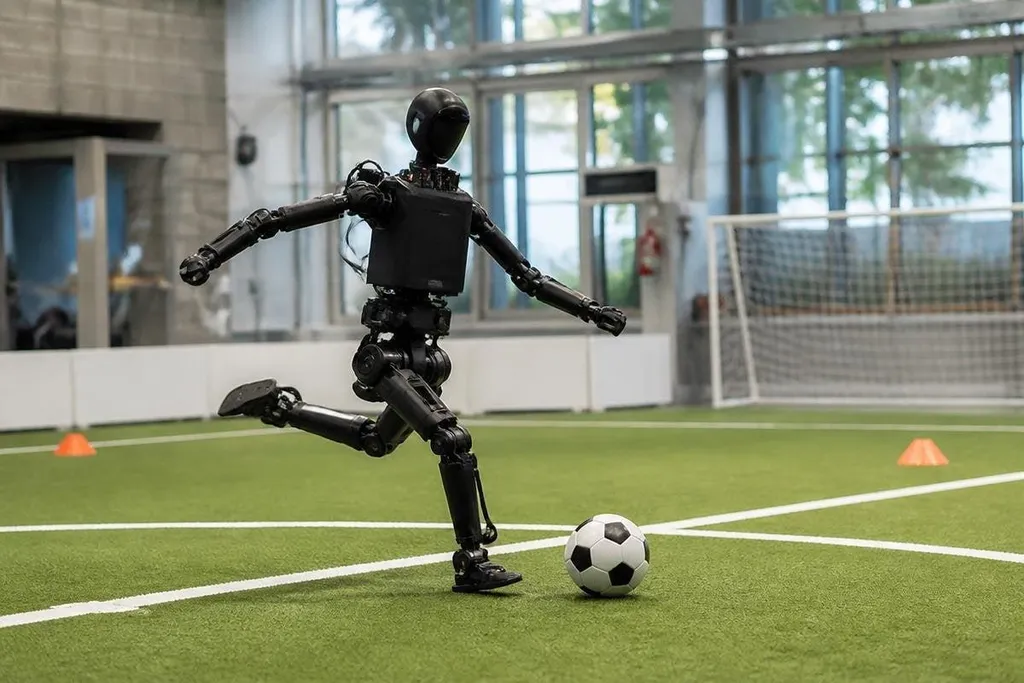
A sports robot can kick a ball, follow a marked course, or copy a trained athlete’s motion. The harder test starts after the clean demo, when the floor changes, the battery drops, and the robot has to recover without help.
This matters to anyone deciding where sports robotics belongs: research lab, training ground, broadcast booth, or live competition.
- Useful work: Robots can train, inspect equipment, record play, or support athletes.
- Hard conditions: Motion, contact, lighting, dust, and uneven ground expose weak systems.
- Proof needed: A short video shows a task. Repeatable results show a system.
What sports robots are being asked to do
Sports robots cover several different jobs. A wheeled system can carry cameras or follow players around a field. A legged robot can test balance, climb steps, or move over ground that would stop a small vehicle. A robotic arm can repeat a swing, serve, throw, or ball-feed motion.
The job decides the design. A camera robot needs quiet motion and steady footage. A training robot needs repeatable timing and safe contact. A competition robot needs sensors, control software, and a way to keep working after a mistake.
That last point matters because sports are full of changes. A ball can bounce in a new direction. A player can block a sensor. Grass, rubber, sand, and painted floors each change how wheels and feet grip the ground.
The useful shift is from tricks to repeatable work
A one-time stunt can prove that a robot completed a task. It cannot show how often the task works, how much human control it needs, or what happens after failure. Those details decide if a sports robot can leave a lab.
A useful test records the full run. It includes failed attempts, recovery time, battery use, sensor limits, and the number of people needed to prepare the robot. The same task should run again under changed conditions, with the changes written down.
A sports robot moving from a public demo to a real deployment needs more than a clean video. The record should name the task, date, control method, and result. Sports robotics reporting from Robot24.com can connect those facts to the hardware limits that matter once the robot shares a field with athletes.
Where the hardware still has work to do
Movement is only one part of the problem. The robot also needs to sense the ball, understand its position, plan a motion, and stop safely when a person enters its path. Each step adds time and another place for an error.
Power creates a separate limit. Fast movement uses more energy, while extra batteries add weight. A robot built for a short match may need a different design from one that trains athletes for several hours.
Human contact raises the bar again. A training robot must limit force near a person and stop when its sensors detect an unsafe position. A system that works well in an empty test area may need slower motion around players.
Cost matters too. A sports club may accept a robot that needs an operator during setup. A small training center may not have staff for daily calibration, repairs, and software updates. The purchase price is only one part of that decision.
A practical test for the next robot demo
Use this checklist before you treat a sports robot as ready for regular work:
- Name the job: Write down the task in one sentence and define what counts as success.
- Count the runs: Ask how many attempts the robot completed, including failures.
- Check human input: Record if a person steered, reset, teleoperated, or selected each action.
- Change the setting: Test another surface, lighting condition, ball type, or player position.
- Measure recovery: Time how long the robot takes to resume after a blocked path or missed action.
- Price the operation: Add staff time, charging, repairs, safety checks, and software costs.
This process also helps separate a research test from a product. A lab system can be useful even when it needs close supervision. The mistake is treating that system as ready for daily sports work before the evidence supports it.
What comes next
The next generation of sports robots will be judged less by one perfect move and more by repeatable work beside people. The useful question is now specific: how many safe runs can the robot complete, on which surface, with how much human help, before it needs a reset?